

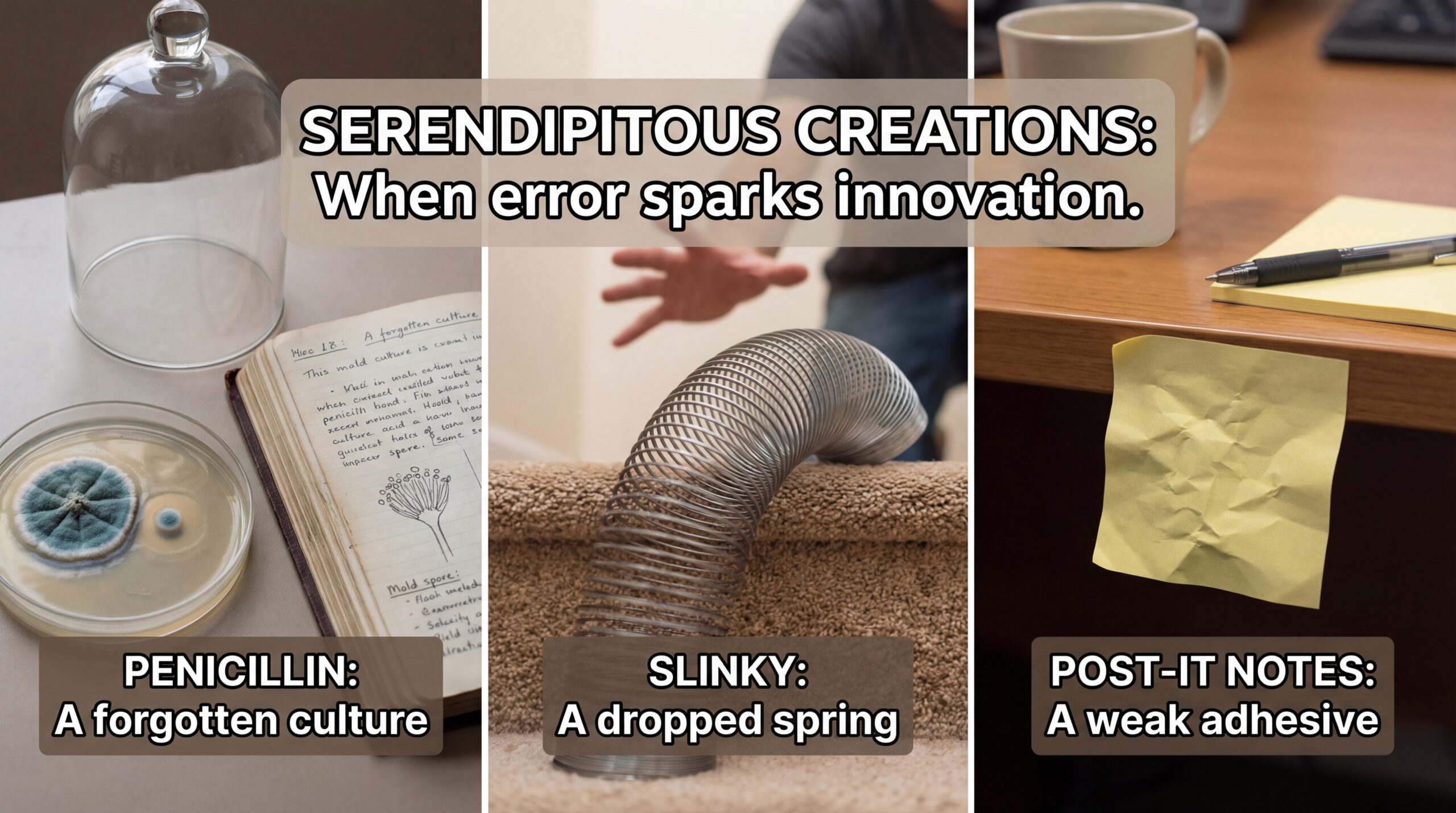
Most life-changing inventions didn’t come from geniuses shouting “Eureka!” under perfect lab lighting.
They came from:
- Mistakes
- Laziness
- Spilled liquids
- Burnt food
- People trying to fix one thing and breaking another
In other words… accidents.
Which is oddly comforting, because it means progress isn’t always about brilliance. Sometimes it’s about noticing what went wrong — and being curious enough not to throw it away.
Here are some of the most important, surprising, and occasionally ridiculous things that were invented by accident — and how the world quietly changed because someone messed up.
Penicillin: The Accident That Saved Millions of Lives
This one isn’t just famous.
It’s legendary.
In 1928, Alexander Fleming wasn’t trying to invent antibiotics. He was studying bacteria. Normal lab work. Routine stuff.
Then he noticed something strange.
A mold had contaminated one of his petri dishes — which usually meant the experiment was ruined. But instead of tossing it out, Fleming looked closer.
The bacteria around the mold?
Dead.
The mold was killing them.
That mold turned out to be Penicillium, and what it produced became penicillin — the world’s first true antibiotic.
Before penicillin:
- Simple infections killed people
- Minor cuts were dangerous
- Surgery was terrifying
After penicillin:
- Modern medicine became possible
All because someone paused before cleaning up a mistake.
Microwave Ovens: When a Candy Bar Melted Science Forward
Percy Spencer was working with radar technology during World War II.
Nothing to do with cooking.
Nothing to do with food.
Then something weird happened.
The chocolate bar in his pocket melted.
Not from heat.
Not from pressure.
From microwaves emitted by the equipment.
Instead of saying “huh, weird” and moving on, Spencer leaned in. He experimented with popcorn. It popped. He tried eggs. They exploded. (Science is messy.)
Fast forward — the microwave oven was born.
Today, it’s a kitchen staple. Back then, it was a happy accident involving melted candy and curiosity.
Post-it Notes: Failure Disguised as Office Supply Gold
Post-it Notes exist because someone failed at making strong glue.
In 1968, a scientist at 3M tried to create a super-strong adhesive. What he got instead was… weak. It stuck lightly and peeled off easily.
Useless, right?
Wrong.
Years later, another employee was annoyed that bookmarks kept falling out of his church hymnal. He remembered that “bad glue” and used it.
Result?
- Sticky notes that don’t damage surfaces
- Reusable reminders
- An office icon
A failed invention became a billion-dollar product — because someone repurposed disappointment.
Potato Chips: Born from Petty Revenge
This one feels personal.
In the 1850s, a restaurant customer kept complaining that his fried potatoes were too thick. The chef, George Crum, was irritated.
So he sliced the potatoes paper-thin, fried them until crispy, and overloaded them with salt — basically saying, “There. Try complaining now.”
The customer loved them.
So did everyone else.
And just like that, potato chips were born — from spite.
Never underestimate the power of mild anger.
Viagra: When a Failed Heart Drug Changed Bedrooms Forever
Viagra was originally developed to treat heart problems, specifically chest pain.
During clinical trials, researchers noticed something unexpected.
Patients weren’t seeing improvement in their hearts — but they didn’t want to give up the drug either.
For… reasons.
Those “side effects” turned out to be the main event.
The drug was repurposed, rebranded, and became one of the most famous pharmaceuticals in history.
A medical failure became a cultural phenomenon.
Super Glue: The Adhesive Nobody Wanted (At First)
Super Glue was discovered while scientists were trying to make clear plastic gun sights during World War II.
Instead, they created a substance that stuck to everything.
Hands.
Tools.
Eyebrows (probably).
Too sticky. Too annoying. Too impractical.
So it was shelved.
Years later, someone realized:
“What if being insanely sticky is the point?”
Today, super glue is everywhere — from household repairs to emergency medicine.
X-Rays: When Curiosity Beat Fear
Wilhelm Roentgen was experimenting with cathode rays when he noticed a fluorescent glow across the room.
That glow shouldn’t have been there.
He experimented further — and discovered rays that could pass through solid objects and reveal bones.
The first X-ray image?
His wife’s hand.
She reportedly said, “I have seen my death.”
Fair reaction.
Despite the fear, X-rays revolutionized medicine forever — all because someone noticed something glowing when it shouldn’t.
Corn Flakes: An Accident Fueled by Religious Zeal
Corn flakes weren’t invented for breakfast joy.
They were invented to reduce sexual desire.
No, seriously.
The Kellogg brothers were experimenting with bland foods as part of a health movement. They accidentally left cooked grain sitting out, then rolled it — creating flakes.
The result was crunchy, light, and surprisingly good.
They abandoned the original moral mission, added sugar, and breakfast cereal was born.
History is weird.
Popsicles: A Frozen Childhood Mistake
In 1905, an 11-year-old named Frank Epperson left a cup of soda and a stirring stick outside overnight.
It froze.
Instead of throwing it away, he ate it.
Years later, he patented the idea and named it the Popsicle.
One forgotten drink.
One cold night.
One childhood curiosity.
Millions of summers improved.
Safety Glass: A Dropped Flask That Refused to Shatter
A scientist dropped a glass flask that should’ve shattered — but it didn’t.
It cracked, but stayed intact.
Turns out the flask had a plastic coating inside.
That accident led to safety glass, now used in:
- Car windshields
- Buildings
- Smartphones
Sometimes the best discoveries are the ones that don’t break.
Pacemakers: A Miscalculation That Saved Hearts
An engineer accidentally built a circuit that delivered electrical pulses — not the continuous signal he intended.
Instead of scrapping it, doctors realized those pulses could regulate heartbeats.
Thus, the pacemaker was born.
A wiring mistake turned into life support.
Chocolate Chip Cookies: The Lie That Worked
Ruth Wakefield expected chocolate chunks to melt into cookie dough.
They didn’t.
Instead, they stayed intact.
Legend says she “invented” chocolate chip cookies by accident — though some claim she knew exactly what she was doing.
Either way, the result changed desserts forever.
And honestly?
I’m okay with not knowing the truth.
Teflon: A Gas That Vanished
A chemist was experimenting with refrigerant gases when one mysteriously disappeared.
The container was still sealed.
Inside, a slippery white substance had formed.
That substance was Teflon — non-stick, heat-resistant, revolutionary.
Sometimes disappearance is discovery.
Velcro: Nature Copying Nature
A Swiss engineer noticed burrs sticking to his clothes after a walk with his dog.
Instead of brushing them off, he examined them under a microscope.
Hooks.
Tiny hooks.
He copied the design — and Velcro was born.
Nature had the blueprint. Humans just paid attention.
Why Accidental Inventions Matter More Than We Admit
Here’s the deeper truth.
Accidental inventions reveal something uncomfortable about innovation:
Progress isn’t linear.
It’s chaotic.
It’s messy.
It’s emotional.
It’s full of wrong turns.
And the people who change the world aren’t always the smartest — they’re often the most observant.
They don’t just ask,
“Did this work?”
They ask,
“Why didn’t it?”
The Hidden Skill Behind Every “Accident”
Curiosity.
Not genius.
Not funding.
Not perfection.
Curiosity.
The willingness to stop, look again, and ask, “What if this mistake matters?”
Most accidents get cleaned up.
A few get questioned.
And those few?
They rewrite history.