
There’s a quiet myth floating around the internet that refuses to die.
It goes like this:
If you don’t pay for ads, you don’t grow.
No traffic. No users. No money. End of story.
It sounds logical. It’s repeated often. And it’s mostly nonsense.
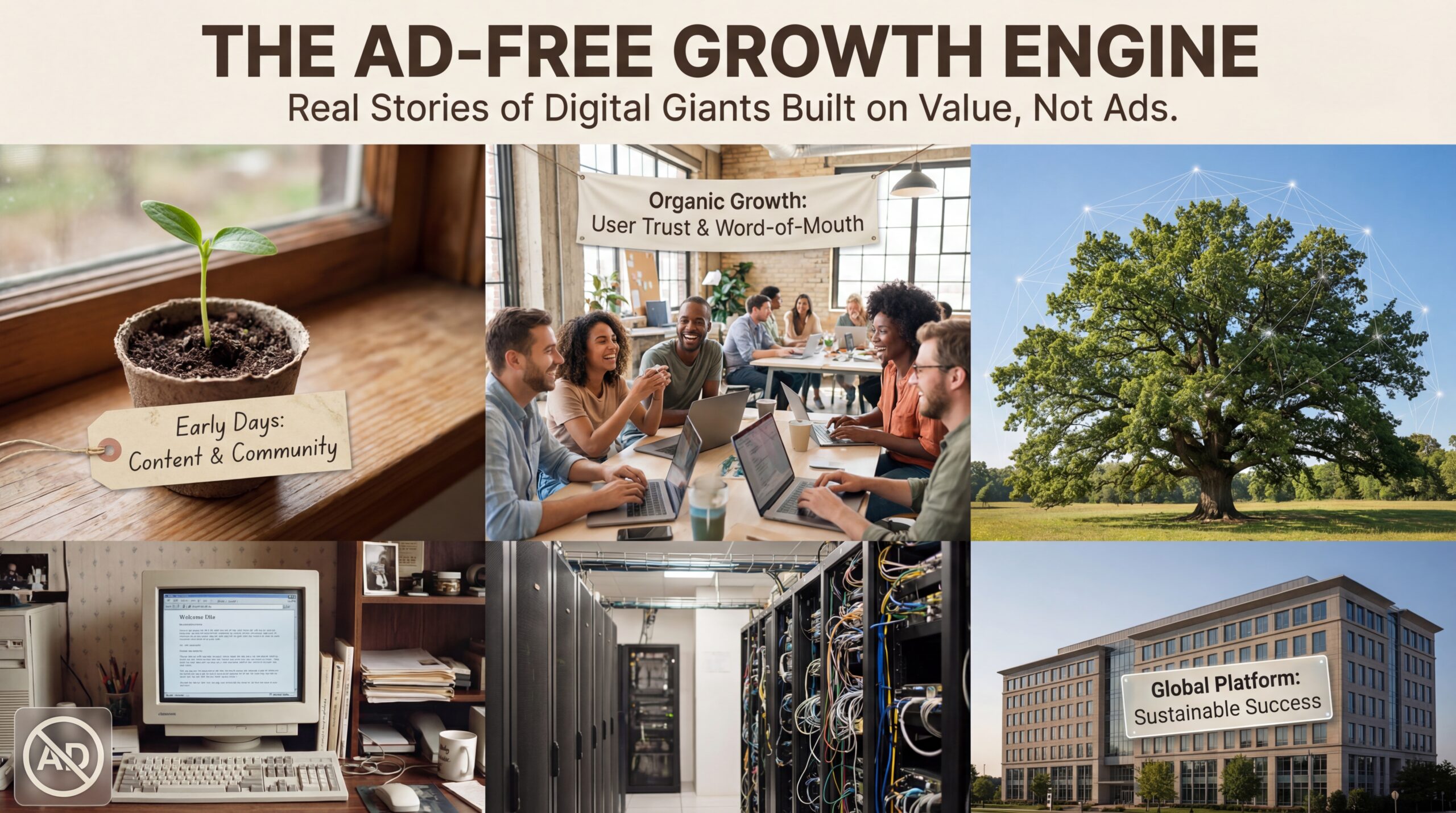
Because scattered across the internet are websites that started small, stayed stubbornly ad-free, and still grew into monsters. Not overnight. Not virally. But steadily, patiently, and — here’s the part marketers hate — without buying attention.
No Facebook ads.
No Google ads.
No influencer shoutouts.
No “growth hacks.”
Just value, timing, and an almost irrational belief that people will share something genuinely useful.
This isn’t a motivational fairy tale.
It’s a pattern hiding in plain sight.
Let’s Clear Something Up First: “No Ads” Doesn’t Mean “No Strategy”
When people hear “grew without ads,” they imagine chaos. Someone launched a site, crossed their fingers, and the internet magically showed up.
That’s not how any of this works.
These websites didn’t avoid ads because they were lazy or broke (although some were).
They avoided ads because ads weren’t the leverage.
Their leverage was:
- Timing
- Obsession with usefulness
- Distribution baked into the product
- And patience most people simply don’t have
That last one matters more than anyone admits.
Craigslist: The Ugliest Proof That Ads Aren’t Required
Craigslist looks like it escaped from 1999 and never looked back.
No design refresh.
No ad campaigns.
No branding theatrics.
And yet, for years, it quietly ate entire industries.
Jobs.
Real estate.
Classifieds.
Local services.
How?
Because Craigslist solved a real problem before platforms got greedy.
It didn’t try to impress.
It tried to be useful.
And once people found it, they didn’t need convincing. They told everyone else because it made their lives easier.
That’s the first lesson:
Word-of-mouth beats ads when the product removes friction.
Wikipedia Didn’t “Market” — It Became Infrastructure
Wikipedia didn’t grow like a startup.
It grew like plumbing.
You don’t advertise plumbing.
You rely on it.
From the beginning, Wikipedia focused on one thing: being the fastest, simplest way to understand anything.
No popups.
No banners.
No growth funnels.
Teachers recommended it.
Students depended on it.
Writers cited it.
Journalists checked it.
It didn’t chase traffic.
Traffic chased it.
Once something becomes a default reference point, ads are irrelevant.
You don’t promote oxygen.
Indie Blogs That Became Empires (Quietly)
Not every example is a global giant.
Some of the most impressive ad-free growth stories come from blogs that did one thing better than anyone else.
Think about sites that:
- Explained complex topics in plain language
- Published consistently for years
- Didn’t chase trends
- Didn’t pivot every six months
They wrote for humans, not algorithms — and the algorithms eventually followed.
Search engines reward depth and trust, not noise.
Readers reward honesty and clarity.
These sites grew slow. Painfully slow.
Then suddenly… they didn’t.
From the outside, it looked like an overnight success.
From the inside, it was years of showing up with no applause.
Stack Overflow: Built on Frustration, Not Funding
Stack Overflow didn’t grow because it was pretty.
It grew because developers were angry.
Angry at vague documentation.
Angry at forums full of half-answers.
Angry at wasting hours stuck on stupid bugs.
So Stack Overflow did something radical:
It made answers brutally direct.
No fluff.
No marketing voice.
No “contact us for solutions.”
Just answers.
Google noticed. Developers noticed. Everyone noticed.
Traffic exploded — organically — because every solved problem became a doorway for the next person.
That’s not advertising.
That’s compounding usefulness.
The Anti-Ad Advantage No One Talks About
Here’s the uncomfortable truth:
Ads can slow you down.
When a website relies on ads to grow, it starts optimizing for clicks, not trust. For impressions, not loyalty.
Ad-free sites have a strange advantage:
They don’t need to please advertisers.
They only need to please users.
That changes everything.
Content gets deeper.
Design stays clean.
Decisions stay aligned.
And users can feel that difference instantly — even if they can’t explain it.
Content That Wasn’t “Optimized” — It Was Obsessive
One pattern shows up again and again.
These sites didn’t publish more.
They published better.
One article that answered everything.
One tool that solved one problem extremely well.
One resource people bookmarked instead of skimmed.
They weren’t playing the volume game.
They were playing the reference game.
Be the page people return to — not the page they bounce from.
That’s how links happen naturally.
That’s how rankings stick.
Timing Beat Talent (And That’s Uncomfortable)
Some of these websites weren’t genius ideas.
They were early ideas.
They showed up before social media was flooded.
Before SEO became industrialized.
Before everyone was yelling for attention.
But timing alone isn’t enough.
Plenty of early sites failed.
The winners stayed when others quit.
That’s the part we conveniently ignore.
No Ads Means Forced Focus
When you can’t throw money at traffic, you’re forced to think.
Who is this actually for?
What problem does it solve?
Why would someone share this?
That pressure sharpens products.
Ad-funded sites can survive being mediocre.
Ad-free sites cannot.
They either become essential… or disappear.
People Share What Makes Them Look Smart or Helpful
This is a human thing, not a marketing thing.
People share:
- Tools that saved them time
- Articles that explained something clearly
- Websites that solved a headache
Not because they were told to — but because sharing felt generous.
Ads try to interrupt behavior.
Great websites become behavior.
Huge difference.
Why Most People Can’t Replicate This (Even If They Try)
Let’s be honest.
Most people don’t fail because ads are expensive.
They fail because patience is expensive.
Building without ads means:
- No instant feedback
- No guaranteed traffic
- No dopamine hits from “campaign results”
You publish into silence.
You improve without praise.
You keep going when logic says stop.
Very few people do that long enough.
That’s why this path works — because it filters out almost everyone.
Ads Buy Attention. Trust Is Earned.
Attention is rented.
Trust is owned.
The websites that grew without ads didn’t rent eyeballs.
They earned belief.
And belief compounds.
Once people trust you, they return.
They link.
They recommend.
No budget can buy that.
The Internet Still Rewards Value (Despite Everything)
Yes, the internet is noisier now.
Yes, competition is brutal.
Yes, ads dominate timelines.
And yet — value still cuts through.
Not fast.
Not dramatically.
But relentlessly.
Search engines still surface the best answers.
People still bookmark useful sites.
Communities still recommend what works.
The rules haven’t changed as much as we pretend.
Our patience has.