

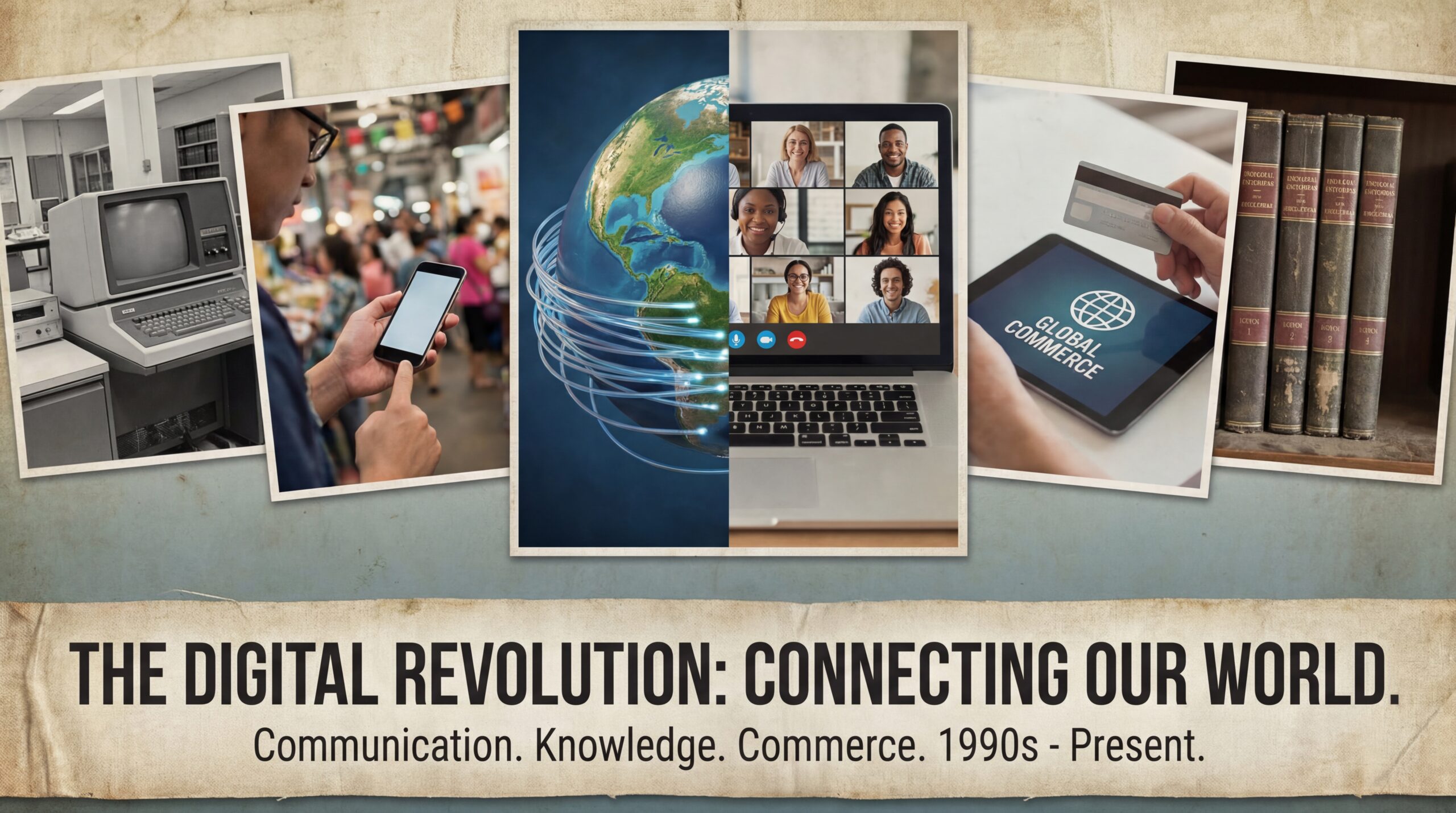
I still remember the sound.
That angry, metallic screech of dial-up internet fighting its way through a phone line like it had something personal against us. You couldn’t use the landline. Pages loaded line by line. Images arrived the way polaroids used to—slowly, awkwardly, and never quite sharp.
At the time, it felt like a toy.
Now? It feels like gravity.
The internet didn’t just change the world. It quietly rewired how humans think, love, argue, learn, work, rebel, and remember. And the wildest part? We’re still pretending it’s “just technology,” when in reality it’s the most powerful social force ever unleashed—more influential than television, more invasive than electricity, more disruptive than the printing press.
That’s not hype. That’s history in motion.
The Internet Didn’t Enter Our Lives — It Moved In
Most inventions arrive politely. The internet kicked the door down and made itself at home.
It didn’t stop at offices or universities. It followed us into bedrooms. Into relationships. Into politics. Into our sense of self.
Before the internet, life had friction. You had to try to know things. You had to go somewhere, ask someone, wait for answers. That friction shaped patience, hierarchy, and authority.
The internet erased friction.
And when friction disappears, power shifts.
Suddenly:
- Teenagers knew more than teachers.
- Freelancers competed with corporations.
- Outsiders built audiences bigger than institutions.
- Governments lost control of narratives.
- Ordinary people became publishers, critics, creators, and whistleblowers.
No permission required.
That wasn’t an upgrade. That was a revolution.
Knowledge Was Once Guarded. Now It Leaks Everywhere.
Once upon a time, knowledge lived behind walls.
Libraries. Universities. Newsrooms. Experts. Gatekeepers.
If you didn’t have access, you stayed ignorant. Simple as that.
The internet blew those walls apart.
Today, a kid with a cracked phone and shaky Wi-Fi can:
- Learn coding for free
- Watch lectures from top universities
- Start a business on Instagram
- Teach themselves a skill that once took years of formal education
This is why the internet terrifies old systems. Not because it’s chaotic—but because it’s uncontrollable.
Education didn’t just move online. Authority collapsed.
Of course, misinformation came along for the ride. Anyone who tells you the internet “democratized truth” is lying through their teeth. What it democratized was access—to truth, lies, brilliance, nonsense, and everything in between.
The burden shifted to the individual.
And that’s a heavy burden most of us were never trained to carry.
Work Stopped Being a Place and Became a Signal
The internet murdered the idea that work equals location.
That shift didn’t happen overnight, but once it started, there was no going back.
Emails replaced memos. Zoom replaced offices. Slack replaced hallway conversations. Google replaced that one coworker who “knew everything.”
Entire industries were born from thin air:
- Digital marketing
- Influencer economies
- Remote consulting
- Online education
- App development
- Content creation
People used to ask, “What do you do for a living?”
Now they ask, “What do you do online?”
That question alone says everything.
The internet didn’t just change how we work—it changed who gets to work, from where, and on whose terms. It blurred the line between hobby and income, personal brand and professional identity.
That’s empowering.
It’s also exhausting.
The Internet Changed How We See Ourselves (And That’s Complicated)
This is where things get uncomfortable.
Before the internet, identity was mostly local. You were known by the people around you. Your reputation had borders.
Now? Identity is global, curated, filtered, edited, optimized.
The internet gave us mirrors everywhere—and none of them show the whole truth.
Social media didn’t just connect us. It turned life into a performance. Likes became validation. Followers became status. Algorithms quietly shaped what we believe we are worth.
And let’s be honest: this messes with your head.
Comparison became constant. Privacy became optional. Silence became suspicious. If you’re not posting, people assume you’re failing.
We gained connection—but lost solitude.
We gained expression—but lost peace.
And yet, people still log in. Every day. Voluntarily.
That contradiction tells you how deep this thing runs.
Relationships Were Rewritten Line by Line
Love letters became texts. Breakups became unread messages. Friendships became streaks.
The internet didn’t kill intimacy—but it rewired it.
You can now meet your soulmate across continents and still feel lonely in a crowded room. You can maintain friendships without seeing faces for years. You can ghost someone without consequences.
Human connection became scalable.
That’s both beautiful and terrifying.
The internet lowered the cost of connection, which also lowered the cost of ending it. Relationships became faster, lighter, easier to replace.
Depth took effort again.
And effort, as we’ve learned, isn’t the internet’s favorite currency.
Politics Couldn’t Survive the Internet Unchanged
This part gets messy—but it matters.
The internet shattered political control over information. Governments no longer own the megaphone. Citizens document everything. Narratives fracture in real time.
That’s why protests organize on messaging apps.
That’s why leaks go viral.
That’s why elections feel chaotic.
That’s why outrage spreads faster than facts.
The internet didn’t make people angry—it gave anger distribution.
And once anger has reach, power trembles.
Of course, manipulation followed. Propaganda adapted. Algorithms learned how to amplify division. Truth became a battlefield.
Still, the old world never came back.
Politics became participatory, volatile, and permanently online.
Culture Stopped Moving Slowly
Before the internet, culture had seasons.
Trends took years. Music traveled slowly. Fame was rare.
Now culture refreshes every week.
Memes become movements. Unknown creators become icons overnight. Languages mix. Humor evolves at lightning speed. Local culture goes global in minutes.
The internet flattened cultural hierarchies. A kid with a phone can influence millions. A joke can define a generation. A video can rewrite narratives.
Culture became fast, chaotic, collaborative.
And yes—sometimes shallow.
But always alive.
The Internet Gave Everyone a Voice. It Didn’t Give Everyone Wisdom.
This is the uncomfortable truth no one likes to admit.
The internet empowered expression—but not discernment.
Everyone can speak. Not everyone should be heard equally.
We live in a world where:
- Expertise competes with opinions
- Facts compete with feelings
- Evidence competes with virality
And the algorithm doesn’t care who’s right. It cares who’s engaging.
That’s the trade-off we made.
Free speech scaled faster than critical thinking.
We’re still paying that price.
Why There’s No Going Back (Even If We Wanted To)
People love to say, “The internet ruined everything.”
That’s lazy thinking.
The internet revealed everything.
It exposed power structures, insecurities, greed, creativity, kindness, cruelty, brilliance, and stupidity—at scale.
It didn’t invent human flaws. It amplified them.
There is no offline world anymore. Even when you log out, the systems remain. Economies depend on it. Relationships rely on it. Memory lives in it.
Trying to “go back” makes as much sense as trying to un-invent fire.
The real question isn’t whether the internet changed the world forever.
It did.
The real question is whether we’re mature enough to live with what we’ve built.
The Internet Is Still Young. That Should Scare You.
Here’s the part that keeps me up at night.
We talk about the internet like it’s finished.
It’s not.
We’re barely decades in. We’re still learning the psychological, social, and political consequences. We’re still raising the first generation that never knew a disconnected world.
This thing will evolve.
And it will keep reshaping us.
Whether we guide it—or let it guide us—that part is still up for debate.