

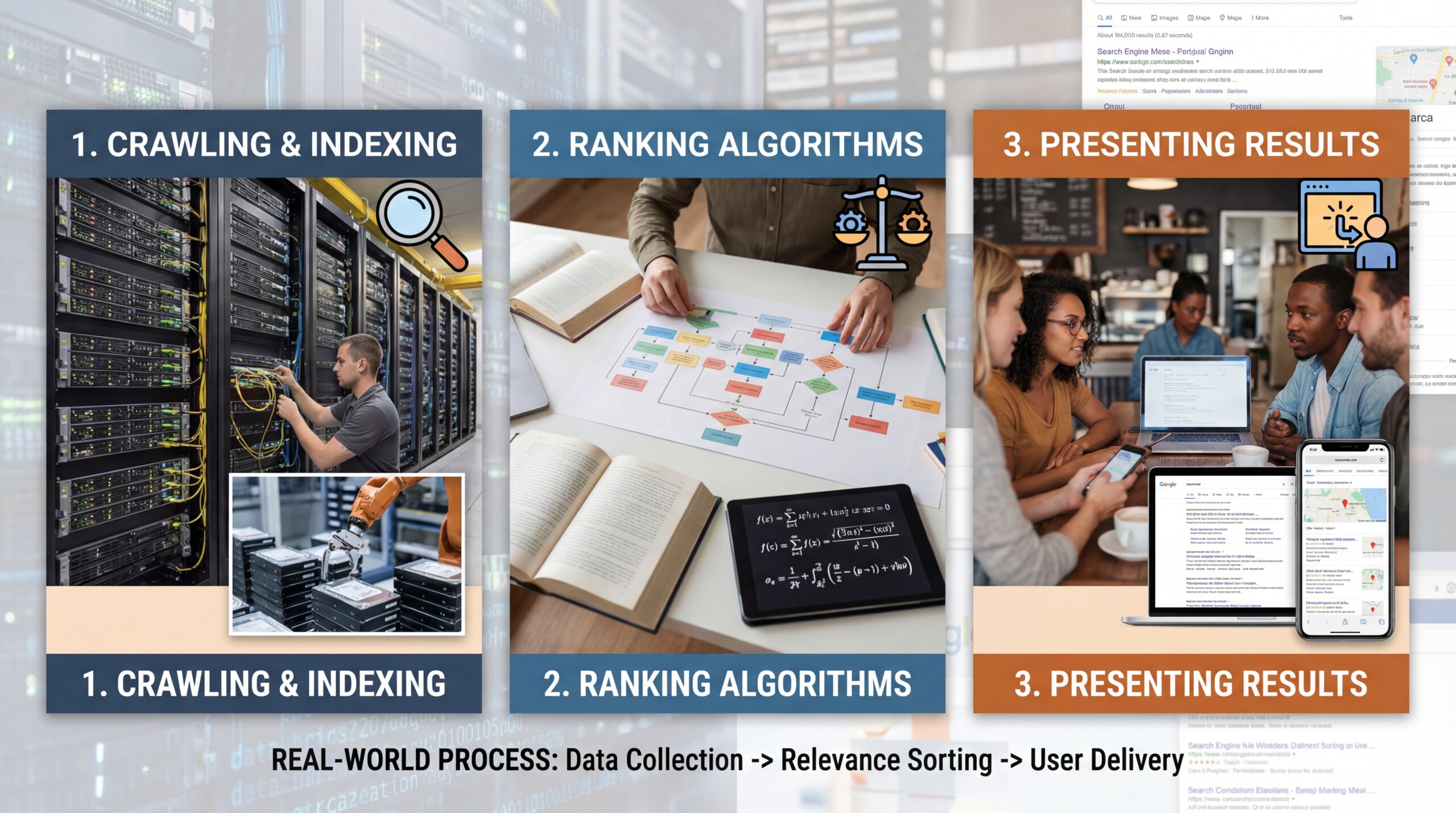
Every time you type something into a search box, something strange happens.
You ask a question.
The internet answers.
Not everything.
Not even most things.
Just a carefully chosen slice of reality.
And it happens so fast you don’t notice the decision being made for you.
But a decision is being made.
The Internet Is Bigger Than What You’ll Ever See
This is the first illusion to break.
When you search something, you’re not “searching the internet.”
You’re being shown what the search engine believes is:
- Relevant
- Trustworthy
- Useful
- And worth your time
There could be millions of pages that technically match your words.
You’ll see maybe ten.
Page two might as well be a graveyard.
So the real question isn’t “what exists?”
It’s “what survives the filter?”
Search Engines Aren’t Librarians — They’re Gatekeepers
People love to imagine search engines as neutral libraries.
You ask. They fetch.
That’s comforting.
It’s also wrong.
Search engines are closer to nightclub bouncers.
They decide:
- Who gets in
- Who waits outside
- Who never makes the list
And they make those decisions based on behavior, patterns, trust signals, and predictions — not just keywords.
Keywords Are Just the Doorbell, Not the House
Yes, keywords matter.
But they’re not the magic spell people think they are.
Typing the right phrase doesn’t guarantee visibility — it just gets the algorithm’s attention.
After that, the engine asks harder questions:
- Does this page actually answer the intent?
- Do people stay or bounce?
- Do other trusted sites reference it?
- Has this source been reliable before?
Keywords open the door.
Everything else decides whether the page gets to stay.
Search Engines Care More About Behavior Than Words
This part surprises people.
Search engines watch what humans do, not just what pages say.
They observe:
- Which result people click
- How long they stay
- Whether they return to search again
- Whether they scroll, skim, or engage
If people click your page and immediately leave, that’s a signal.
If they stay, read, and stop searching — that’s a stronger signal.
Search engines learn from crowds.
Not opinions.
Actions.
Trust Is Built Slowly — And Lost Quietly
Search engines don’t trust new websites.
Not because they’re evil — but because trust has to be earned.
They look for signs like:
- Consistency over time
- Depth instead of surface-level content
- Clear authorship or authority
- Natural links from other sites
A brand-new site shouting “trust me” won’t rank.
An old site that’s quietly helped people for years often will — even with average content.
History matters.
Reputation sticks.
Freshness vs. Depth: A Constant Tug-of-War
Some searches want the latest information.
Others want the best explanation ever written.
Search engines try to guess which one you want.
That’s why:
- News topics show recent pages
- Tutorials surface older, authoritative guides
- Evergreen questions favor depth over date
They’re not ranking pages — they’re ranking answers.
And sometimes they get it wrong.
Personalization Changes What You See (Even If You Don’t Notice)
Two people can search the same phrase and see different results.
Why?
Because search engines quietly factor in:
- Location
- Language
- Past searches
- Device type
- Search history
Not dramatically — but subtly.
You’re not seeing the internet.
You’re seeing your version of it.
Filtered through what the system believes you’re likely to want.
Authority Isn’t About Fame — It’s About Signals
A small website can outrank a huge one.
But only if it sends the right signals.
Authority looks like:
- Being cited by other trusted sources
- Covering a topic comprehensively
- Staying focused instead of scattered
- Avoiding clickbait tricks
Search engines don’t reward loudness.
They reward reliability.
Slow, boring, consistent reliability.
Why Clickbait Sometimes Wins (Temporarily)
You’ve seen it.
Thin articles ranking high.
Overhyped headlines.
Content that feels… empty.
This happens because algorithms learn over time.
If enough people click something, it rises.
If enough people bounce, it falls.
Clickbait exploits curiosity — but rarely satisfies it.
That’s why it spikes… then fades.
Sustainable visibility comes from satisfying intent, not just attracting it.
Search Engines Hate Confusion
One of the strongest ranking signals is clarity.
Clear topic.
Clear structure.
Clear purpose.
Pages that try to cover everything usually rank for nothing.
Pages that answer one question extremely well tend to stick.
Ambiguity is the enemy.
Search engines don’t want to guess what your page is about.
Links Are Still Votes — Just Not All Votes Count
Links still matter.
But not all links are equal.
A link from a trusted, relevant site acts like a recommendation.
A link from spam? Ignored or worse.
Search engines read link patterns the way humans read social circles.
Who trusts you matters more than how many know your name.
Why Some Great Content Never Gets Seen
This is the part no one likes.
Some excellent pages never rank.
Not because they’re bad — but because:
- They’re buried on weak sites
- They lack visibility signals
- They never earn references
- They don’t align cleanly with search intent
Search engines don’t reward effort.
They reward evidence.
The Algorithm Isn’t Evil — It’s Impatient
Search engines don’t hate creators.
They hate wasting users’ time.
Their entire survival depends on one thing:
showing something useful, fast.
Anything that threatens that goal gets demoted.
Anything that supports it gets amplified.
That’s it.
No morality.
No feelings.
Just incentives.
SEO Isn’t About Gaming the System Anymore
Old-school tricks still exist — but they decay fast.
Modern search rewards:
- Depth over volume
- Helpfulness over hype
- Structure over cleverness
- Consistency over spikes
Trying to trick the algorithm is exhausting.
Helping the user is simpler — and more durable.
The Search Engine Is Always Learning From You
Every click trains the system.
Every skipped result sends feedback.
You are not just searching.
You are teaching.
Which is slightly unsettling — and incredibly powerful.
Why the First Result Feels “Right”
The top result often feels authoritative.
Not because it’s perfect — but because it’s been validated repeatedly.
It survived countless micro-tests across users, locations, and time.
Ranking is not a crown.
It’s a survivor badge.
This Is Why SEO Takes Time (And Why That’s the Point)
If rankings changed instantly, search engines would be chaos.
Stability matters.
That’s why progress feels slow.
That slowness is protection — against manipulation, noise, and nonsense.