

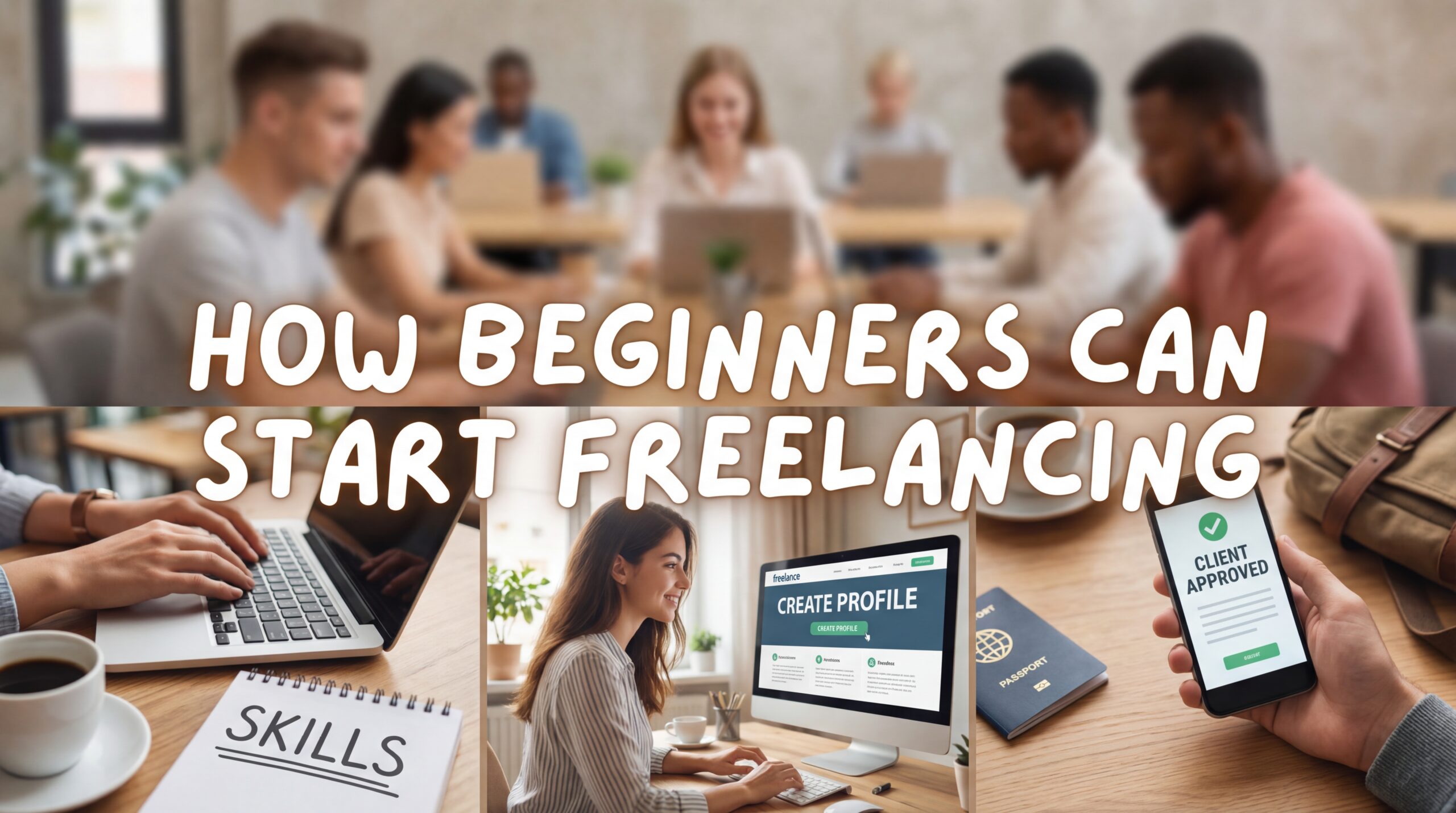
Most freelancing advice starts with a lie.
It tells you to “find your passion,” “build a personal brand,” or “just put yourself out there,” as if confidence magically appears the moment you open a laptop.
That’s not how it works.
Most beginners don’t fail at freelancing because they’re lazy or untalented. They fail because nobody explains the in-between stage — the awkward, unpaid, confusing phase where you don’t feel like a beginner anymore but you’re definitely not a professional either.
This guide is for that phase.
Not the Instagram version of freelancing.
The real one.
The one where you’re figuring things out while doubting yourself quietly.
First, Let’s Kill the Biggest Myth About Freelancing
You do not need to be an expert to start freelancing.
You need to be:
- Slightly ahead of someone else
- Willing to learn in public
- Reliable
- Honest about what you can and can’t do
That’s it.
Freelancing is not about mastery. It’s about solving problems for money.
Once you understand that, everything becomes simpler.
Step 1: Pick a Skill That’s Boring but Useful
Beginners often choose skills they love instead of skills people pay for.
That’s backwards.
The easiest freelancing skills to start with are usually:
- Writing (blogs, captions, emails)
- Graphic design (basic social posts, thumbnails)
- Video editing (short clips, reels)
- Social media management
- Data entry or virtual assistance
- Simple website edits
- Research and lead generation
None of these require genius. They require consistency.
Here’s a rule that works:
If businesses already pay for it, beginners can freelance it.
You can specialize later. Right now, boring is good. Boring pays.
Step 2: Accept That Your First Work Might Be Ugly
This part hurts, but it’s necessary.
Your first projects will not represent your “true potential.”
They’ll represent your starting point.
And that’s okay.
Beginners who wait until they feel ready usually never start. The ones who accept imperfect work build experience faster.
Think of your early freelancing phase as paid practice.
You’re not building a legacy yet.
You’re building evidence.
Step 3: Create Proof Before You Create a Brand
You don’t need:
- A fancy website
- A logo
- A brand color palette
- A personal tagline
You need proof.
Proof can be:
- Sample projects
- Mock work
- Before-and-after examples
- Practice assignments
- Case-style explanations
If you’re a writer, write.
If you’re a designer, design.
If you’re an editor, edit.
Make 3–5 solid samples and explain:
- What the problem was
- What you did
- Why it matters
Clients care more about results than aesthetics.
Step 4: Choose One Platform (Not All of Them)
This is where beginners usually spiral.
They try:
- Upwork
- Fiverr
- Freelancer
- Cold emails
All at once.
That’s a mistake.
Pick one platform and learn how it works deeply.
For beginners:
- Fiverr works well for productized services
- Upwork works well for proposals and longer-term clients
- Facebook groups work well for direct outreach
- LinkedIn works well for professional services
Master one ecosystem before expanding. Momentum matters more than visibility.
Step 5: Learn How to Write a Proposal That Sounds Human
Most proposals fail because they sound like templates.
Clients don’t want:
“Dear Sir, I am very interested in your project…”
They want:
“I read your post. I see the problem. Here’s how I’d approach it.”
A good beginner proposal:
- Mentions the client’s problem directly
- Explains a simple solution
- Shows relevant experience (even small)
- Feels conversational, not desperate
You don’t need to be impressive. You need to be clear.
Clarity builds trust faster than confidence.
Step 6: Price Low — But Not Desperate
Yes, beginners should charge less.
No, beginners should not charge nothing.
Free work attracts:
- Unclear expectations
- No respect
- No commitment
Low-paid work attracts:
- Learning opportunities
- Real deadlines
- Feedback
- Experience
Charge enough that you take the work seriously.
Then raise your rates slowly as:
- Your speed improves
- Your confidence grows
- Your results get better
Freelancing is a staircase, not an elevator.
Step 7: Expect Rejection (And Don’t Personalize It)
Here’s something nobody tells beginners:
Most proposals are ignored.
Not rejected. Ignored.
That doesn’t mean:
- You’re bad
- You’re unqualified
- You should quit
It means:
- The client got overwhelmed
- The budget changed
- Someone else applied earlier
- Timing was off
Rejection in freelancing is rarely personal. Treat it like background noise.
Consistency beats motivation here.
Step 8: Learn Client Communication Early (This Is Huge)
Skill gets you hired once.
Communication keeps you hired.
Beginners who succeed long-term:
- Ask clarifying questions
- Confirm expectations
- Give updates
- Admit mistakes early
- Meet deadlines
You don’t need to be charming. You need to be reliable.
Clients forgive average work.
They don’t forgive silence.
Step 9: Build Systems Before You Burn Out
Freelancing beginners often overwork themselves trying to “prove” something.
That leads to burnout fast.
Even early on, build small systems:
- Fixed work hours
- Clear scope boundaries
- Simple contracts or agreements
- Organized files
- Time tracking
Freedom without structure turns into chaos.
Structure creates sustainability.
Step 10: Separate Your Identity From Your Work
This one is emotional — and important.
If you tie your self-worth to every client response, you’ll suffer.
Freelancing involves:
- Ghosting
- Late payments
- Scope creep
- Bad feedback
- Unfair criticism
None of these define your value.
Treat freelancing like a business, not a personality test.
Detachment is not laziness. It’s professionalism.
Common Beginner Mistakes (Learn From Others’ Pain)
Let’s be honest about what trips people up:
- Waiting too long to start
- Underpricing out of fear
- Overdelivering to please everyone
- Accepting unclear projects
- Ignoring contracts
- Saying yes to everything
- Comparing themselves to experts
Every freelancer you admire made these mistakes — just earlier.
How Long Does It Actually Take to Succeed?
Not overnight.
Not instantly.
Not in one viral moment.
For most beginners:
- First paid project: weeks to months
- Consistent income: several months
- Confidence: longer than expected
- Stability: earned, not given
Freelancing rewards patience disguised as persistence.
A Reality Most Gurus Won’t Say Out Loud
Freelancing is not freedom in the beginning.
It’s uncertainty.
It’s learning under pressure.
It’s doing work you’re not fully confident in yet.
But over time, it becomes:
- Control over your schedule
- Choice over clients
- Ownership of your skills
- Income tied to effort, not permission
That transition is worth the discomfort.